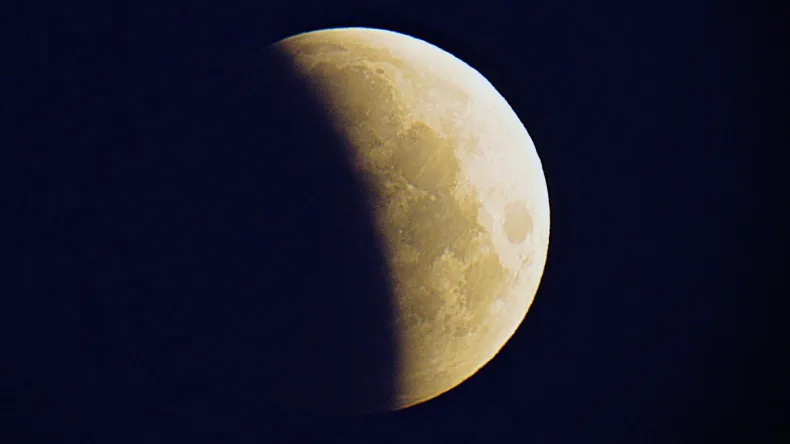
A deep partial lunar eclipse will be visible from Algeria on Friday, August 28, 2026. The celestial event is anticipated to offer observers in the region a significant astronomical display, marking a notable occurrence for sky-watchers across the nation. This particular eclipse is expected to present a captivating spectacle as the moon passes through Earth's shadow, creating a dramatic visual effect in the early morning hours.
Eclipse Timing and Magnitude
The celestial event will see approximately 96.3 percent of the moon's disk fall within Earth's shadow at its peak, indicating a deep partial eclipse rather than a total one. This high percentage of obscuration promises a vivid and noticeable transformation of the lunar surface. The moon's entry into Earth's penumbra, the lighter, outer part of the shadow, is scheduled to begin at 02:23 local time in Algeria. This initial phase, while subtle, marks the official commencement of the eclipse as the moon first encounters Earth's extended shadow.
Following this, the moon's entry into the Earth's umbra, the darker, central part of the shadow, will occur around 03:33 local time. It is during this phase that the most dramatic visual changes will become apparent to observers. As more of the moon enters the umbra, its illuminated portion will gradually diminish, often taking on a reddish or orange hue due to sunlight scattering through Earth's atmosphere.
The maximum eclipse, when the largest portion of the moon is obscured, is projected for approximately 05:13 local time. At this point, nearly the entire lunar disk will be immersed in the deep shadow, leaving only a sliver of direct sunlight to illuminate its edge. Observers in Algeria will witness the moon setting around 06:22, a key detail for planning observations as the event will still be underway. The partial phase of the eclipse is expected to conclude around 06:51 local time, marking the end of the visible event as the moon fully emerges from Earth's umbral shadow. The entire sequence, from penumbral entry to the end of the partial phase, will span several hours, providing ample opportunity for observation.
Observational Guidance
The upcoming lunar eclipse presents a distinctive astronomical phenomenon for both observation and photography. Its profound visual impact makes it an ideal subject for amateur astronomers and casual observers alike. Successful viewing will require a completely unobstructed western horizon, according to astronomical guidance. This is particularly important given that the moon will be setting during the latter stages of the eclipse, meaning any terrestrial obstructions like buildings or trees could hinder the view. Finding an elevated spot or an open field with a clear line of sight to the west will significantly enhance the viewing experience.
Unlike solar eclipses, which necessitate specialized protective eyewear, lunar eclipses can be observed safely with the naked eye, posing no risk to vision. This inherent safety makes it an accessible event for everyone, from young children to seasoned astronomers. There is no requirement for special glasses or protective equipment to view the event, allowing for direct and comfortable observation of the moon's changing appearance. Binoculars or a small telescope can further enhance the experience, revealing more details of the lunar surface and the subtle color variations during the eclipse.
Expert Confirmation
The Center for Research in Astronomy, Astrophysics and Geophysics (CRAAG) confirmed the details regarding the deep partial lunar eclipse. This scientific institution, a key authority in astronomical observations and research within Algeria, verified the timing and visibility parameters for the celestial event. CRAAG's confirmation provides a foundational and authoritative basis for the public information concerning the eclipse, ensuring accuracy for those planning to observe the phenomenon. The center's role includes monitoring and disseminating information about significant astronomical occurrences, such as lunar eclipses, to the Algerian public and scientific community. Their confirmation shows the reliability of the eclipse's projected schedule and characteristics, offering peace of mind to those eager to witness this rare and beautiful cosmic display. The precise data provided by CRAAG allows for optimal planning by individuals and educational institutions wishing to organize viewing sessions.