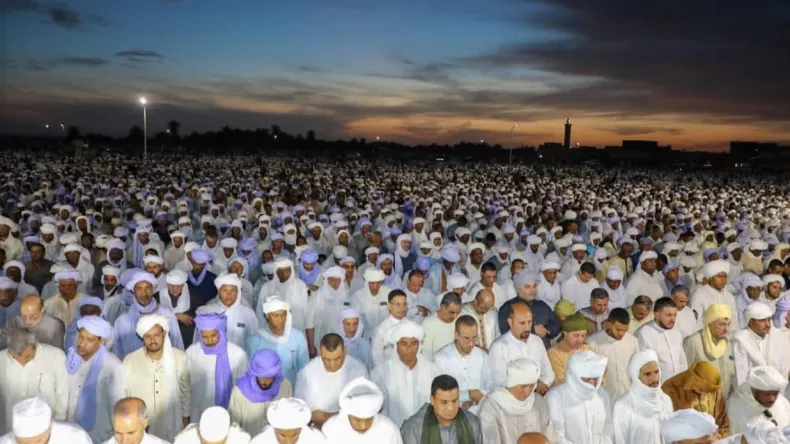
An annual commemoration of Sheikh Moulay Abdullah Al-Raqani (1682/1735 AD) took place in Reggane, Adrar province, over two days, from May 1st to May 2nd. The author attended the event, which is held annually on these dates by the Zawiya Raqania. The author's invitation came from his friend Salem bin Mubarak, who previously served as mayor of Bouda and as Vice-President of the National Assembly. This region of Reggane was also noted by the author as the site where France conducted nuclear tests between 1960 and 1966, a historical detail that adds a layer of complex memory to the locale. The author reflected on the event, stating, "Innovation is an addition to religion, and it is never an investment in 'God's days' to remind believers of their glories, of the nation's scholars, and of what they left behind. It is an occasion to gather people for Quran recitation, its completion, communal prayer, and pride in belonging to this nation." The author added that it serves to "remind them of what has faded from their religion, what has departed from their values, and what they have become immersed in concerning their worldly affairs, to the point where religion has become strange, and the nation's scholars and preachers are forgotten." This annual gathering thus serves as a vital spiritual anchor for the community.
Preserving Islamic Heritage and Faith
The Zawiya Raqania's activities are credited with preserving three key aspects of Islamic life, according to organizers: the memorization of the Quran among the youth, the protection of the Arabic language, and the safeguarding of the Sunni Madaahib, or schools of thought. These efforts show the Zawiya's role as a guardian of traditional Islamic learning and practice. Participation in the annual commemoration is open to all, with attendees typically not requiring formal invitations to renew their faith. This open invitation fosters a sense of communal belonging and shared purpose among the participants. The event commences with a complete recitation of the Quran, known as a khatma, a deeply spiritual act that sets the tone for the proceedings. It concludes with communal prayers. These prayers are offered for Sheikh Moulay Abdullah Al-Raqani, all present and absent attendees, Algeria, the broader Islamic nation, and Palestine, encompassing a wide scope of supplication. The commemoration draws a significant number of participants, with male attendees numbering no less than 4,000. This substantial turnout notes the enduring reverence for Sheikh Al-Raqani and the importance of the event to the community. Women also participate in the event, constituting approximately a quarter of the male attendance and observing the proceedings from a separate designated section, ensuring their involvement while adhering to cultural norms.
The Scholar and His Legacy
Sheikh Moulay Abdullah Al-Raqani, who lived from 1682 to 1735 AD, is remembered as a scholar, jurist, and renewer of his era, dedicated to serving the Quran and Sunnah. His life and teachings continue to inspire generations. The author, reflecting on the annual commemoration, reiterated his perspective that innovation (bid'ah) represents "an addition to religion, and it is never an investment in 'God's days' to remind believers of their glories, of the nation's scholars, and of what they left behind." The author elaborated that such events serve as "an occasion to gather people for Quran recitation, its completion, communal prayer, and pride in belonging to this nation." These gatherings also aim to "remind them of what has faded from their religion, what has departed from their values, and what they have become immersed in concerning their worldly affairs, to the point where religion has become strange, and the nation's scholars and preachers are forgotten." This critical observation shows the perceived need for such spiritual revivals. The author observed that during the prayers, certain phrases were used that he advises against, specifically those related to 'figh al-wasila wal-tawassul' (jurisprudence of means and intercession), indicating a nuanced theological discussion even within the commemorative framework.
A Grandson's Wisdom and Divine Links
The main lecture of the year's commemoration was delivered by Sheikh Moulay Abdullah Al-Raqani's grandson, focusing on the themes of obedience to parents and gratitude toward both God and one's parents. The lecture, which lasted approximately 50 minutes, incorporated citations from Quranic verses, Hadith, and sayings of the righteous predecessors, according to attendees, enriching its message with foundational Islamic texts. It also noted three specific divine links, presented as inseparable tenets of faith and practice. The Sheikh's grandson stated, "Indeed, God linked three things, and He does not accept one if it is separated from its pair: He linked His obedience with the obedience of His Messenger; He linked prayer with Zakat; He linked His worship with kindness to parents." This powerful statement emphasized the interconnectedness of these spiritual and societal duties for believers, presenting a holistic view of religious observance and ethical conduct. The lecture served as a central educational component of the commemoration, reinforcing core Islamic values for the large gathering.