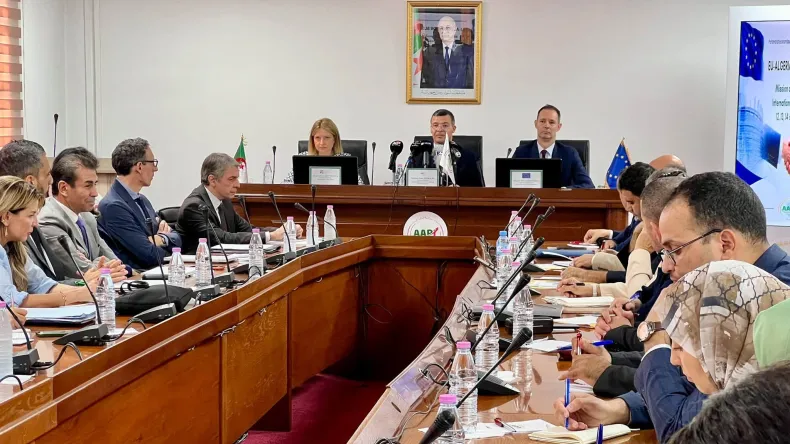
Algeria and the European Union officially launched the 'EU–ALGERIA FOR BUSINESS' program on 13 October. This initiative operates under the guidance of the Algerian Investment Promotion Agency and the International Trade Centre, with oversight from Omar Rekkache, Marco Miliorelli, Elena Boutrimova, and Mohamed Soumani. The partnership provides a framework for economic cooperation and private sector development across the country. Officials designed the 'EU–ALGERIA FOR BUSINESS' program to last for 60 months. This duration sets the timeline for the implementation of various trade-related activities and business support services throughout the region. The project aims to improve investment conditions for local and European enterprises by streamlining regulatory engagements and enhancing industrial collaboration over the five-year period.
The 'EU–ALGERIA FOR BUSINESS' program is designed to last for 60 months. This fixed timeline ensures that the participating organizations have a stable window to execute the strategic goals established by the European Union and the Algerian government. By establishing this 60-month commitment, the partners intend to provide a consistent environment for private sector stakeholders to navigate the regulatory landscape and engage in long-term industrial planning.
Program Goals and Pillars
Three primary pillars define the operational scope of the program. These components include the improvement of the business climate and the promotion of investment, the facilitation of trade alongside the digitization of customs procedures, and the support of product quality and environmental standards. The program focuses on these three main pillars to ensure a full approach to economic development. By addressing the business climate, the initiative seeks to foster a more predictable environment for capital allocation. The focus on digitizing customs procedures is intended to reduce administrative burdens for companies operating between the two jurisdictions, while the commitment to environmental standards and product quality is designed to align local outputs with international requirements.
Preparatory meetings for these objectives began on 12 October 2026 at the headquarters of the Algerian Investment Promotion Agency. These sessions are scheduled to continue until 14 October 2026. The meetings held at the headquarters of the Algerian Investment Promotion Agency serve as the foundation for the upcoming activities. During this period, representatives are finalizing the operational roadmap to ensure all parties are prepared for the full implementation of the program. Omar Rekkache, Director General of the Algerian Investment Promotion Agency, stated, "The preparatory meetings aim to prepare an integrated and practical program that includes measurable goals and concrete measures that respond to the needs of investors and institutions, by clarifying investment opportunities, expanding economic partnerships, facilitating trade exchanges, and strengthening support directed at institutions to access markets."
Technical assistance for the program comes from the International Trade Centre. The European Union commissioned this agency to provide the necessary expertise and guidance for the implementation of the specified pillars. By utilizing the International Trade Centre, the European Union ensures that the program benefits from specialized knowledge regarding global trade practices and institutional capacity building. This collaboration is central to the project's success, as the International Trade Centre provides the technical framework required to meet the objectives defined by the three pillars of the program. Through this partnership, the European Union and the Algerian Investment Promotion Agency intend to create a sustainable model for economic cooperation that addresses the specific requirements of the local market while fostering stronger ties with European commercial entities.